

Malabar Pit Viper in Wayanad: A Fascinating Snake of the Western Ghats

27AUG
Malabar Pit Viper in Wayanad: A Fascinating Snake of the Western Ghats
The forests of Wayanad are home to many fascinating creatures, including some that are remarkably difficult to spot. Among them is the Malabar Pit Viper, a venomous snake closely associated with the moist forests of the Western Ghats.
With its striking colours, distinctive head shape and remarkable camouflage, the Malabar Pit Viper is one of the most interesting reptiles that nature enthusiasts may encounter in the forests of Wayanad.
For visitors exploring the natural surroundings of Jungle Park Resort, spotting one can be an unexpected and memorable part of experiencing the biodiversity of the Western Ghats.
Conclusion
The Malabar Pit Viper may not be as immediately noticeable as an elephant, deer or colourful forest bird, but it represents an equally fascinating part of Wayanad's biodiversity.
Its striking appearance, remarkable camouflage and association with the forests of the Western Ghats make it an interesting species for anyone fascinated by reptiles and the natural world.
At Jungle Park Resort, being surrounded by forest creates opportunities to notice these smaller details of nature. Sometimes, the most memorable wildlife encounters are not with the largest animals, but with the species that require patience and a closer look.
And somewhere among the leaves, a Malabar Pit Viper may be quietly waiting — almost invisible until you learn how to look.
Explore the forest surroundings, discover fascinating reptiles and experience the biodiversity of the Western Ghats during your stay.
🌿 Book your stay at Jungle Park Resort
What Is the Malabar Pit Viper?
The Malabar Pit Viper, scientifically known as Trimeresurus malabaricus, is a venomous pit viper endemic to the Western Ghats.
The word endemic means that the species has a naturally restricted distribution. In the case of the Malabar Pit Viper, its presence is closely associated with the forests of the Western Ghats, making it a distinctive part of this region's biodiversity.
Like other pit vipers, it has specialised heat-sensing pits between its eyes and nostrils. These sensory organs help the snake detect warm-blooded prey in its surroundings.
How to Recognise a Malabar Pit Viper
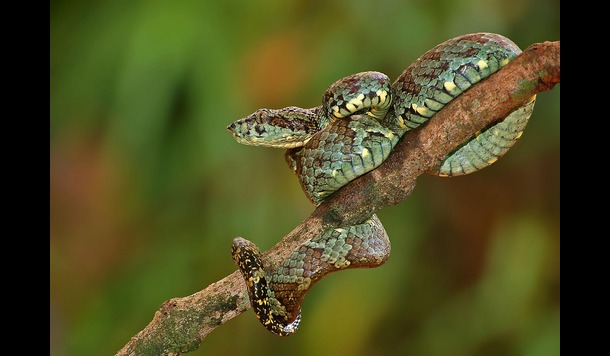
One of the most noticeable characteristics of the Malabar Pit Viper is its appearance. Individuals can show different shades and patterns, including green, brown and earthy colours that help them blend into their surroundings.
Its triangular head, vertically elliptical pupils and distinctive body pattern are characteristic features of a pit viper.
The variation in colour and pattern also makes individual sightings interesting, particularly for wildlife photographers and reptile enthusiasts.
A Master of Camouflage
The Malabar Pit Viper is exceptionally well adapted to remain hidden in forest vegetation.
A snake resting among leaves, branches and damp vegetation can be surprisingly difficult to distinguish from its surroundings. This natural camouflage allows the snake to remain concealed while waiting for suitable prey.
For visitors walking through the forest, a Malabar Pit Viper may be nearby without being noticed. This is one reason why slow and careful observation can reveal details of the forest that are easily missed.
Where Is the Malabar Pit Viper Found?
The Malabar Pit Viper is associated with the moist forest habitats of the Western Ghats.
Wayanad's humid climate, seasonal rainfall, streams, dense vegetation and forest cover provide the kind of environment in which reptiles and amphibians can thrive.
The forests around Jungle Park Resort form part of this larger Western Ghats landscape, offering nature lovers an opportunity to experience a diverse range of smaller forest creatures.
What Does the Malabar Pit Viper Eat?
The Malabar Pit Viper is an ambush predator. Instead of actively chasing prey over long distances, it can remain concealed and wait for an opportunity.
Its diet can include small animals found within its forest habitat, such as frogs, lizards and other suitable prey.
This behaviour makes its camouflage and ability to remain still important parts of its survival strategy.
Why Is the Malabar Pit Viper Important to the Western Ghats?
The Malabar Pit Viper is more than an interesting reptile to observe. As a species associated with and endemic to the Western Ghats, it represents the unique biodiversity of this mountain range.
The Western Ghats supports a remarkable variety of reptiles, amphibians, birds, mammals and other forms of life. Protecting the forests and microhabitats that support these species is therefore important for maintaining the wider ecosystem.
Every species, including less familiar forest reptiles, forms part of the ecological network that keeps the forest functioning.
Malabar Pit Viper Around Jungle Park Resort
The natural surroundings of Jungle Park Resort provide an opportunity to experience the quieter and less obvious side of Wayanad's wildlife.
Guests exploring the forest surroundings may encounter a variety of smaller creatures, including frogs, insects, reptiles and other forms of forest life. The Malabar Pit Viper is one of the species that makes such encounters particularly fascinating.
Sightings are never guaranteed because these are wild animals moving freely through their natural habitat. The snake's camouflage and secretive behaviour also mean that even when it is present, it may remain hidden.
For nature lovers, this uncertainty is part of what makes wildlife observation exciting.
Best Time to Look for the Malabar Pit Viper
There is no fixed time or location where a wild Malabar Pit Viper can be guaranteed to appear.
Moist weather and periods following rainfall can make the forest particularly interesting for reptile and amphibian observation. The increased moisture brings activity to many parts of the ecosystem.
If you are exploring around Jungle Park Resort, moving slowly and observing vegetation, branches and damp areas carefully can increase the chances of noticing smaller wildlife.
A Fascinating Subject for Wildlife Photography
The Malabar Pit Viper can be a fascinating subject for wildlife photography because of its colours, patterns and remarkable camouflage.
A photographer may be able to capture details that are difficult to appreciate from a distance, particularly when the snake is naturally positioned among leaves or branches.
However, the animal should never be approached, touched, moved or disturbed for the sake of getting a better photograph. Using a suitable lens and maintaining a safe distance is always the better approach.
Respecting the Malabar Pit Viper
The Malabar Pit Viper is venomous and should always be treated with caution and respect.
If you encounter one in the forest, maintain a safe distance and allow it to remain undisturbed. Do not attempt to handle, corner, provoke or move the snake.
Responsible wildlife observation means allowing animals to behave naturally while visitors enjoy the experience from a respectful distance.
Why Nature Lovers Enjoy Jungle Park Resort
Natural forest surroundings in Wayanad
Rich reptile, amphibian and wildlife diversity
Opportunities to observe smaller forest creatures
Suitable surroundings for nature and wildlife photography
Western Ghats landscape with dense vegetation and seasonal moisture
Quiet environment for slow and responsible wildlife observation