

Trekking at Jungle Park Resort – Wayanad’s Highest and Most Scenic Adventure Stay

16JAN
Trekking at Jungle Park Resort – Wayanad’s Highest and Most Scenic Adventure Stay
If you're looking for a resort in Wayanad, Kerala, South India that offers an unforgettable trekking experience, Jungle Park Resort should be at the top of your list. Nestled deep within a tropical jungle at 4,300 feet above sea level, this is not just the highest resort in Wayanad—it’s the only one that unlocks a world of trekking trails, hidden waterfalls, unique birdlife, and even a sea view from the Western Ghats.
At an elevation of 4300 feet, Jungle Park Resort is not just the highest resort in Wayanad — it's over 1000 feet higher than any other property in the region. Nestled deep within a remote tropical forest, this mountaintop resort sits right on the edge of the Western Ghats, offering a weather phenomenon unlike any other in Kerala or even India.
Thanks to its unobstructed westward location, Jungle Park enjoys a direct line of sight to the Arabian Sea, which lies about 60 km away. This unique geographic position triggers an orographic effect, where moist air from the sea ascends the Ghats and condenses into clouds, rain, and mist — right at the resort. Jungle Park is the first and only point that breaks this cloud path, making it one of the only properties in India to receive consistent rainfall and mist throughout the year, regardless of the season.
Add to that the constant cool breeze, dense jungle surroundings, and breathtaking mist-covered lake views, and you have a setting that’s 7°C cooler than most parts of Wayanad — even during peak summer. Whether you’re escaping the heat, searching for the most pristine weather in Kerala, or just craving misty mountain mornings, Jungle Park offers a truly unmatched climate experience.
Conclusion
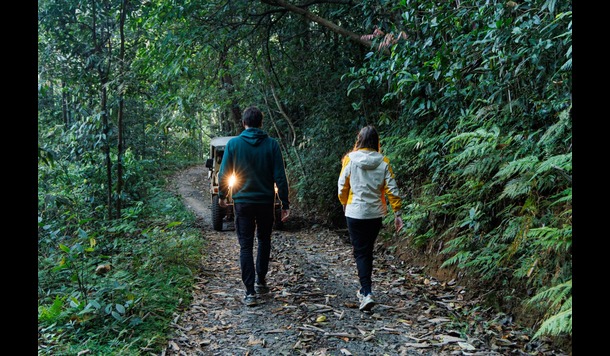
There’s no noise here. No roads, no shops, no traffic. Once you check into Jungle Park, you’re completely surrounded by 900 acres of private, pristine wilderness. The trails are not marked with signboards. They’re guided by naturalists, following animal tracks and forest clues. Every step is immersive.
Hidden Waterfall Treks
One of the resort's biggest draws is its exclusive trekking trails that lead to hidden waterfalls tucked deep within the rainforest. These trails are only accessible to guests of Jungle Park and are perfect for early morning treks when the mist hangs low and birdsong fills the air.
The terrain varies from moss-covered rocks to bamboo groves and red-earth paths, offering a raw, untouched feel. These are not tourist-trodden trails — they’re off-the-map jungle paths for those who seek real adventure.
The Highest Viewpoint in Wayanad – With a Sea View
There are viewpoints — and then there's the highest viewpoint in Wayanad. From a secret ridge accessible only via a guided trek from the resort, you can see all the way to the Arabian Sea, 60 km away on a clear day. Jungle Park even provides binoculars to help you spot this incredible horizon line, where the Western Ghats meet the sky.
This is one of the very few places in Asia — and possibly the only one in India — where you can trek in the forest and end your hike with a distant view of the sea.
Birding Like Nowhere Else
Due to its unique altitude and climate, Jungle Park is home to several endemic bird species that are rarely spotted elsewhere in South India. Trekking through the property gives you the chance to see hill mynas, Malabar whistling thrushes, and even the elusive Nilgiri flycatcher.
Birdwatchers and nature photographers can spend hours along these forest trails spotting birds that are only found at this elevation in Kerala, India.
Herping – For the Wild at Heart
The rich biodiversity also makes Jungle Park a hidden paradise for herping — the observation of amphibians and reptiles in their natural habitat. Guests often spot rare frogs, lizards, and snakes, particularly during night walks or monsoon treks. This is a thrilling and educational add-on for nature lovers, herpetologists, and wildlife photographers.
The Jungle Trekking Experience – Raw, Remote, Real
There’s no noise here. No roads, no shops, no traffic. Once you check into Jungle Park, you’re completely surrounded by 900 acres of private, pristine wilderness. The trails are not marked with signboards. They’re guided by naturalists, following animal tracks and forest clues. Every step is immersive.